Income Tax Demand Notice: Meaning, Reasons and Response Steps for Taxpayers in India
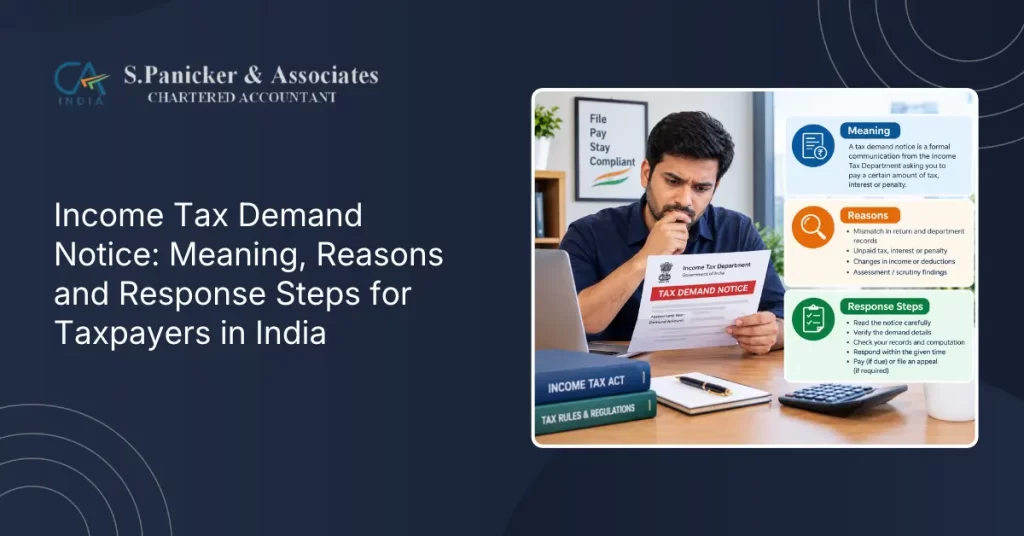
An income tax demand notice is a written request from the Income Tax Department to pay money it believes you owe. That money can be tax, interest, a fee, or a penalty. You usually have 30 days to pay it, accept it, or dispute it on the e-filing portal.
This guide covers the full income tax demand notice India process, from checking the notice to filing a reply. It is written for taxpayers in Thane, the rest of Maharashtra, and every other part of the country.
What Is an Income Tax Demand Notice?
An income tax demand notice is a formal order to pay an outstanding amount under Section 156 of the Income Tax Act, 1961. The department sends it when your tax paid falls short of your tax due.
Receiving one does not mean you did something wrong. Many notices come from a small gap between your return and the department’s data.
Either the Centralised Processing Centre or an Assessing Officer can issue an income tax demand notice. You will see it on the portal and receive it by email.
One update matters here. The Income-tax Act, 2025 took effect on 1 April 2026, but older years still follow the 1961 Act. Check the section number on your income tax notice before you act.
Taxpayers often mix up three notices. This table sets them apart.
| Notice Type | Purpose | Your Action |
| Intimation under Section 143(1) | Shows the result of return processing | Pay, agree, or disagree |
| Demand notice under Section 156 | Asks you to pay a due amount | Respond within 30 days |
| Scrutiny notice under Section 143(2) | Selects your return for detailed review | Submit documents and explanations |
Why Do You Receive an Income Tax Demand Notice?
You receive an income tax demand notice when the department calculates more tax than you paid. These are the usual causes:
- Your return shows income that differs from Form 26AS or the Annual Information Statement (AIS).
- A deductor failed to report the TDS you claimed.
- You claimed a deduction without proper support.
- Self-assessment tax or interest was never paid.
- Section 234F added a late filing fee.
- You entered the wrong assessment year on a challan.
Late filing and short advance tax also add interest under Sections 234A, 234B, and 234C. That interest increases the amount in your income tax demand notice.
Most income tax demand notice India cases begin with a simple data mismatch.
Job changers see this a lot. Say you worked for two employers in one year and reported only one salary. Both employers filed TDS, so the department sees the second income and sends you an income tax notice.
How Do You Check an Income Tax Demand Notice Online?
Log in to the e-filing portal and go to Pending Actions, then Response to Outstanding Demand. Every income tax demand notice India issues shows up on that page.
- Open the e-filing portal and log in with your PAN and password.
- Click Pending Actions.
- Choose Response to Outstanding Demand.
- Open the entry and note the assessment year, section, amount, and interest.
You can download the income tax demand notice from this page. Save a copy, because you will need its details when you reply.
Before you respond, compare the figures with Form 26AS and AIS. It takes a few minutes and can save you from a wrong reply.
Also, update your email and mobile number on the portal. The department sends every income tax notice to those contacts.
How Do You Respond to an Income Tax Demand Notice?
You can agree, partly agree, or disagree with the demand on the portal. You can also request payment in instalments.
The income tax demand notice India rules give you 30 days from the date of service.
| Your View | What You Do | What Happens Next |
| Demand is correct | Pay through e-Pay Tax | Demand closes after payment |
| Partly correct | Pay the agreed part and explain the rest with proof | Department reviews the balance |
| Already paid | Add your challan details | Department matches your payment |
| Disagree | Upload reasons and documents | Department reviews your case |
Think before you pick an option. A wrong choice can slow down the review of your tax demand notice. Also confirm the final payable amount, since interest may keep adding up.
The portal accepts net banking, debit cards, and other listed modes. A few habits help:
- Pay with the same PAN and assessment year.
- Keep the challan receipt.
- Reply before day 30 ends.
What Should You Do If the Income Tax Demand Notice Is Incorrect?
Select Disagree on the portal, upload proof, and file a rectification request under Section 154 if the error is plain on the record.
First, find where the error started. Put the income tax demand notice next to Form 26AS, AIS, and your challans.
If the deductor reported TDS wrongly, ask them to file a corrected TDS return. If your own return has the mistake, file a rectification request or, where the law allows, a revised return.
Here is a typical case. A share seller in Thane finds capital gains in AIS that the return missed. Contract notes and a corrected computation back up the reply.
Gather Form 16, Form 26AS, AIS, bank statements, and deduction proofs before you write anything. Clear records make your reply easier to review.
Do not click Disagree on an income tax demand notice without evidence. The department may just confirm the demand.
If the order on your income tax notice stands, you can appeal to the Commissioner of Income Tax (Appeals) within 30 days of receiving it. A late appeal needs a valid reason.
The department may also adjust your refund against the demand under Section 245. A timely reply on the portal lets you raise your objection first.
What Happens If You Ignore an Income Tax Demand Notice, and When Should You Get Expert Help?
Ignoring an income tax demand notice adds 1% interest per month under Section 220(2) and can lead to recovery action.
- Interest keeps growing until you pay.
- The department can hold back your refunds.
- Officers can act against your bank account or assets.
- A penalty under Section 221 may follow.
Delay in an income tax demand notice case only raises the final bill.
Talk to a professional in these situations:
- The demand is large or spans several years.
- The notice comes with scrutiny or reassessment.
- You earn business, capital gains, or foreign income.
- You cannot find the reason for the mismatch.
Local help also saves time. Taxpayers in Thane can speak with a tax consultant in Thane about any income tax notice.
A clear plan makes any income tax demand notice India sends easy to handle, and an early reply keeps costs low.
Stay connected with S. Panicker & Associates for regular tax, GST and finance updates. Follow us on Facebook and Twitter, or message us anytime on WhatsApp.
Also Read: Best Income Tax Consultant in Mumbai: How to Choose Expert in 2026
What Are the Most Common Questions About an Income Tax Demand Notice?
What is an income tax demand notice?
It is a Section 156 request to pay tax, interest, or a penalty that the department says you owe.
How long do I have to respond?
Under the income tax demand notice India rules, you normally have 30 days from the date of service.
Can I pay in instalments?
Yes. You can request instalments from the Assessing Officer, who decides on the request.
Can the department adjust my refund?
Yes. Under Section 245, it can set off your refund against the demand after giving you notice.
Is every income tax notice a demand notice?
No. Scrutiny and other notices ask for information, while a demand notice asks for payment.
Recent Post